
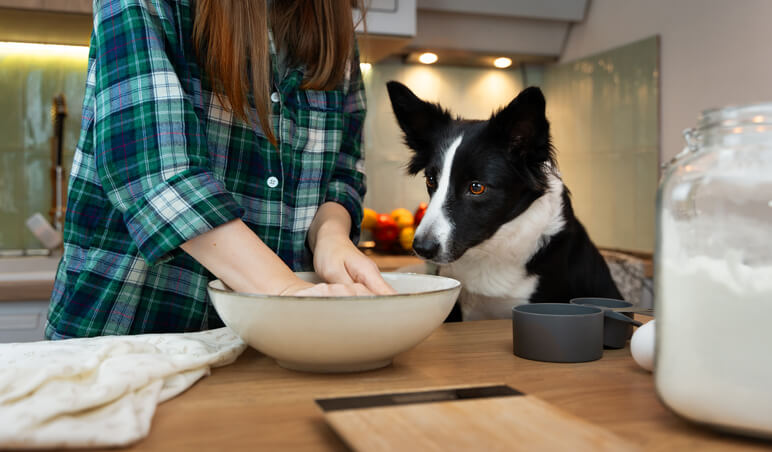
Kitchen Crimes: Why Dogs Steal Food (and What You Can Do About It)
If you’ve ever walked into the kitchen to find your dinner missing or discovered your dog standing suspiciously close to an empty trash can, you’re not alone. Food stealing is one of the most common challenges we hear about—and one of the most frustrating.
The interesting part? It’s also perfectly normal dog behavior.
Why Do Dogs Steal Food?
What likely led to the domestication of dogs? A few functions that often come up are keeping us warm, alerting us to threats, and eating garbage and food waste to help minimize pests and predators. Scavenging wasn’t a bad habit—it was a valuable job.
So when we ask our dogs to ignore food on the counter, stay out of the trash, or leave the table alone, we’re asking them to go directly against instincts that have been reinforced for thousands of years.
That doesn’t mean we can’t teach better habits. It just means it’s important to remember that while dogs live in our homes, they’re still animals with their own way of experiencing the world.
A Clever Dog (Maybe Too Clever!)
One of Kristen’s favorite kitchen stories goes back about 15 years to a mastiff in class. His family added a jingle bell collar so they could hear whenever he was sneaking into the kitchen.
The problem?
He learned how to walk without making the bells ring.
After about six weeks of training, the family shared what could have been a disaster—or a huge success. They accidentally left an entire bag of chicken on the counter while they were gone for a few hours. When they came home…
The chicken was still there.
While we definitely don’t recommend testing your dog’s training this way, it was an incredible milestone after years of successful food theft.
Three Ways to Prevent Kitchen Crimes
Rather than thinking only about stopping food stealing, we like to think about three different pieces of the puzzle.
1. Prevention
The easiest kitchen crime to solve is the one that never happens.
Ask yourself:
- Does the trash need to be inside a cabinet or have a secure lid?
- Should the kitchen be off-limits during meal preparation?
- Would baby gates or closed doors help during busy times?
- Does your puppy need something productive to do while you cook?
This is especially important because getting into the wrong foods—or the trash—can become a medical emergency.
Just as importantly, look for safe ways to satisfy your dog’s natural scavenging instincts. Scatter meals in the yard, stuff a puzzle toy, use a lick mat, or let your dog tear apart a cardboard box with treats hidden inside. Giving dogs appropriate opportunities to forage often reduces the desire to create their own adventures.
2. Training
Management is important, but we also want dogs to learn the skills they’ll use every day.
One option is teaching a dog to relax on a mat or dog bed while you prepare meals. This works wonderfully during predictable, high-temptation moments.
We also love teaching an automatic leave it, where the sight of food becomes the cue to leave it alone rather than waiting for the handler to give a command.
If your dog only ignores food because you’re standing there saying “leave it,” then your presence—not the food—is controlling the behavior. The long-term goal is helping your dog make good decisions even when you aren’t actively directing them.
3. When Mistakes Happen
No dog is perfect, and mistakes are part of the learning process.
When your dog does make an error, we don’t want them to successfully reward themselves by eating the food. At the same time, we also don’t want to accidentally teach that they only stay away from food because we’re watching.
Finding that balance between preventing reinforcement and building independent decision-making is often the trickiest part of training—and one of the reasons having a plan ahead of time can make such a difference.

Leave a Reply